My Daughter's Wedding Was Three Weeks Away. The Suit Fit. The Photos Didn't.
My daughter's wedding was three weeks out, and I had just tried on the suit.
The suit fit. That was not the problem. The problem was the face above the collar. My wife took a photo in the fitting room — the kind you send to check the jacket — and when it came back I did not look like a proud father three weeks from the best day of the year. I looked exhausted.
I felt fine. I want to be clear about that. I was not tired, I was not run down, I was not unwell. But in every fitting-room photo, the bags under my eyes made me look worn out — and these were not photos that would disappear. These were the photos my family would frame and keep on the wall for the next thirty years.
I was not trying to look younger. I did not want work done. I just did not want to be the tired-looking man in the corner of my own daughter's wedding pictures.

Three weeks is not a lot of time — so I got specific
Once there is a date on the calendar, "I'll deal with it eventually" stops being an option. I had three weeks, a face that photographed tired, and no real idea what actually worked. So I did the thing I should have done years earlier: I stopped guessing and started finding out what was genuinely going on under the eye — and what could realistically change it in the time I had.
Here is what I tried, what it cost, and the ninety-second explanation that finally made sense of all of it.
What I tried, in order, and what it cost
Sleep. Obviously. I did eight hours a night for two months straight, which is the single most common piece of advice you will get and the most useless. It helped the morning puffiness slightly. It did nothing about the shadow or the texture. Which was the first clue that "get more sleep" was not a diagnosis — it was a way of ending the conversation.
Water and cutting back on drinking. Down to almost nothing for three weeks. Genuinely good for other reasons. Did not touch this.
My wife's eye cream. I used it for about a month, in secret, feeling ridiculous. Then I bought one marketed at men, which cost $45 and came in a black bottle and did exactly the same amount of nothing. Somewhere in there I worked out that the black bottle was the entire product difference.
A metal roller thing from Amazon. $22. Cold, fine, forgotten in a drawer within two weeks.
Caffeine, cold water on the face, the sixty-second things men do instead of admitting there is a problem. All of it buys you about an hour.
Then I looked at what the actual fix costs. Lower eyelid surgery, which is the only thing anyone could tell me definitively works: $3,000 to $6,000, general anesthetic, and — this was the part that ended it for me — a week to ten days where you cannot go to work looking like that.
So I did what men do, which is nothing, for another eighteen months.
And I want to name the thing that made the nothing so easy, because I suspect it is the same for you: there was no in-between option. Women who have this problem can at least cover it. There is an entire industry built for that. For men there is a $45 black bottle that does not work, and there is surgery. Nothing sits between those two.
Which left the question I could not answer: if the cheap thing does nothing and the expensive thing is two weeks off work, why is there nothing in the middle?
The answer, from a dermatologist's assistant, in about ninety seconds
I was in for a mole check. Entirely unrelated. While we waited she asked, making conversation, what I was using on my under-eyes, and I told her about the black bottle.
She nodded in the way people do when they have heard something a thousand times.
Then she explained the thing that reframed two years and about $70 of black bottles.
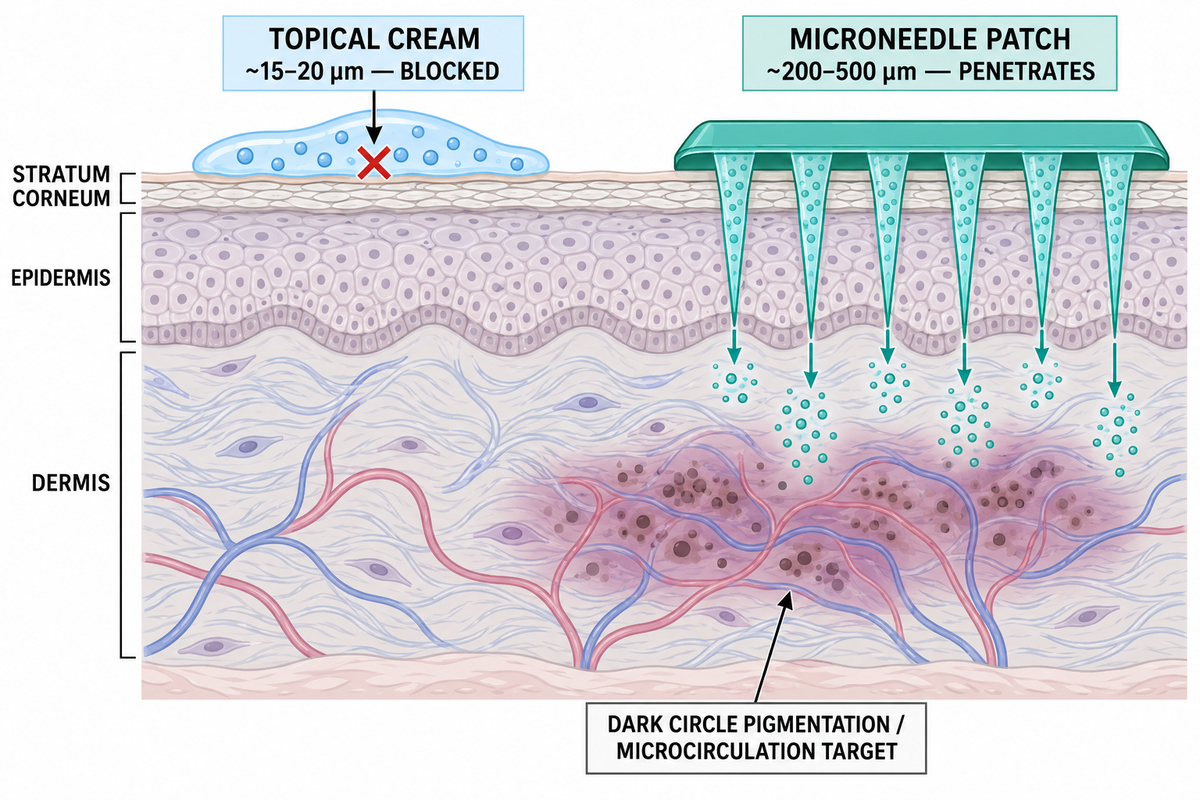
The outer layer of your skin — the stratum corneum — is not a wrapper. It is a barrier, and keeping things out is its entire biological job. Bacteria, irritants, water loss. It is extremely good at it, and it does not make an exception because you spent money.
So when you rub a cream on, most of the active ingredient never gets through. Some sits on the surface and comes off on the pillow. Some evaporates. A fraction makes it in. That fraction is doing all the work.
"And under the eye it is worse," she said, "because that skin is the thinnest on your body. So anything strong enough to actually push through would sting the eye. Which means eye products get formulated weak on purpose. You have got a deliberately weak formula going up against a barrier built to block it."
Weak formula. Strong barrier. Thinnest skin on the body.
Then the line that did it:
I want to be accurate here, because this is where these articles normally overreach. She was not saying creams do nothing — they hydrate, and hydration is real. She was saying something narrower and far more useful.
The problem was never what was in the bottle. It was that it never got in.
Which means the question — which one should I buy? — was wrong from the start. The right question is: is there anything that does not have to get through the barrier at all?
I looked it up myself that night
Because I was not going to take a hallway conversation as fact. Here is what is actually published, by people with nothing to sell me.
In plain terms: a cream stops at the door, and almost nothing gets through. A microneedle patch starts on the other side of that door. That single difference — where the active is placed, not what the active is — is why two years of black bottles did nothing, and this did not.
What it is, and what it is not
When she said "microneedle" I pictured the spiked roller you see online that draws blood, and I told her that was not happening anywhere near my eye.
That is not this. She was clear about the distinction and it matters.
A dissolving microneedle patch contains no metal. The cones on the underside are made from the actives themselves — freeze-dried and compressed into solid points, shorter than a grain of salt. They do not reach nerve endings, they do not draw blood, and they do not stay in there. You press the patch on, the cones sit just inside the top layer, and over a few hours they dissolve completely — releasing their contents on the far side of the barrier that stopped every bottle you ever bought.
What is in the cones
The detail that convinced me was how the patch feels — cool, translucent and surprisingly lightweight. There is no serum sloshing around in it, because the patch is not a delivery vehicle for a serum. The patch is the dose.
It also explains why you cannot shortcut this with something cheaper. Hyaluronic acid on the surface hydrates the surface. The delivery is the mechanism, not the ingredient list. A bottle containing all five of those, rubbed on top of the barrier, is the same black bottle I already owned.
Three weeks, written down as it happened
I ordered them with roughly zero expectation. My actual thought was that it cost less than the black bottle and I could stop after the first week.
Days 1–7 — the starter week
Slight prickle for a minute the first night, then nothing. The actives release under the skin overnight, so by the morning the puffiness looked smoother and I woke up looking fresher and more hydrated than I went to bed. Early and subtle, but real — and the point where you decide it is worth finishing.
Week 2 — it stops being subtle
The dark shadows started to brighten and the morning puffiness was visibly reduced. Not dramatic yet, but the first morning I looked in the mirror and did not immediately reach for the concealer.
Week 3 — the reset lands
This is where it came together. The shadows were clearly lighter, the puffiness stayed down through the day, and the whole area looked smoother and more rested — eyes that read as rested even on the mornings I was not. Three weeks in, this was the visible reset.
Ongoing — two treatment nights a week
After the starter week, keep to four treatment nights a week through the reset, then two treatment nights a week to hold it. Each treatment is a fresh sealed pouch — two patches, one per eye, used once. It takes about fifteen seconds to apply, with no complicated routine or downtime — and the firmness and brightness have quietly kept improving since.
Precision matters here, so:
I do not have the eyes I had at thirty-five. I still have some fullness in the mornings and I expect I always will, because my father has exactly these eyes and so does my brother — that part is structural and no patch touches it.
What changed is the reading. Nobody has asked me if I was up late in four months. Nobody has asked if everything is alright at home. The face stopped filing reports I did not authorize.
And the performance review this year did not mention energy.
See if this fits your situation →What I wanted to know before I ordered
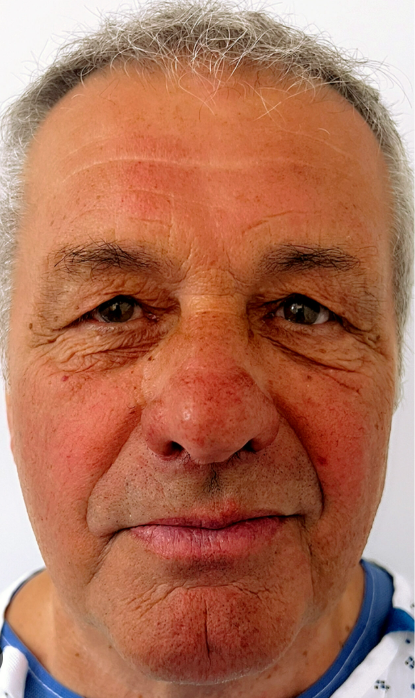
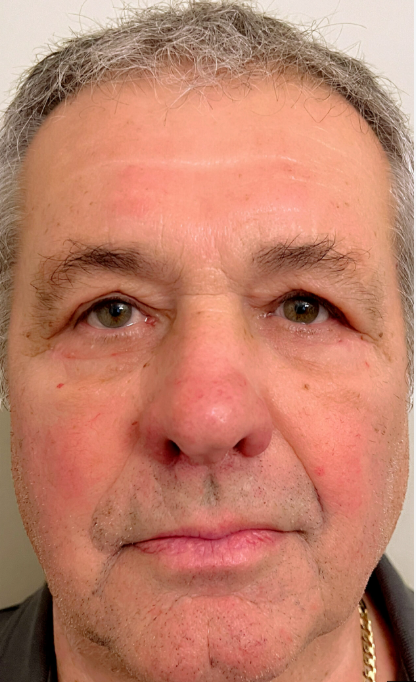
Two people asked if I'd been on holiday. I hadn't — I'd just stopped looking tired on the morning calls.


I'm 61 and skeptical of anything labeled 'anti-aging.' Week three was when the shadow finally started looking lighter.


I nearly booked the surgery. I'm glad I tried this first — my eyes look more rested, and I didn't have to take time off work.
"Is this makeup? Is anyone going to be able to tell?"
No, and no. It is not a cover-up and there is no color in it — nothing is left on your skin in the morning beyond what has already absorbed. You wear them overnight. Nobody sees the product, and there is nothing to detect on your face the next day.
"Is this going to turn into a routine?"
Press on one pair before bed — a patch under each eye — and peel them off in the morning. Four treatment nights a week while you reset, then two treatment nights a week. There is no cleanser step, no serum step, nothing to layer, and nothing that needs to live on a shelf where people can see it.
"Does it hurt?"
A prickle for the first minute while the cones soften, then you stop noticing. They are far too short to reach a nerve. Sharp pain is not normal — take it off.
"My bags are genetic. Dad had them, granddad had them."
Then read this bit carefully, because it is the honest answer rather than the one that sells more. If the fullness is inherited fat pads — the kind visible in photos of you at twenty-five — no patch, cream or serum shifts those. Surgery does. What responds is everything else: fluid, thinning skin, lost firmness, the texture that catches hard light. Most men are a mix of both, which is why two guys the same age get different results. If you are mostly the first kind, save your money.
"Why has no doctor mentioned this to me?"
Mine had not either. Primary-care and dermatology appointments are short and triaged toward medical problems. Cosmetic delivery methods do not come up unless you raise them. It is a fifteen-minute appointment, not a conspiracy.
"I have sensitive skin / I react to things."
Patch test on the inner forearm, wait 24 hours. If you have eczema, dermatitis or rosacea around the eye, or broken skin, skip it. Mild pink that fades within half an hour is expected. Swelling, itching or burning is not — stop and email them.
What I had already spent before I spent this
- $45 on the black bottle, plus my wife's before that
- $22 on the roller in the drawer
- $3,000–$6,000 quoted for surgery, plus 7–10 days not being able to show my face at work
- Two years of being read as tired, annoyed, or slowing down
Cebeam is $39.95 — a 7-Day Starter with four treatment pairs — one pair per treatment night.
Less than one round of drinks with clients. Less than the black bottle plus the roller combined. And no days off work.

CEBEAM Under-Eye Reset — 7-Day Starter
$39.95
7-Day Starter — 4 treatment pairs. Use one pair per treatment night during your first week. 90-day money-back guarantee, and you keep the box.
Get CEBEAM →The bit that made it a low-stakes decision
90 days, box open, used.
The 7-day starter is where it begins to change, and by three weeks the reset is usually clear — less puffiness, lighter shadows, a more rested read. Skin this thin still moves on its own schedule, so some men see it settle sooner and some a little later. Which is why the window is a full 90 days rather than thirty — long enough to judge it fairly, and you keep the box either way.
Nothing goes back in the post. No form asking you to prove it did not work.
So the only thing you are actually out is the 7-day starter and the 21-day reset — a patch a couple of nights a week.
The CEBEAM Under-Eye Reset
Two options, and one of them is disguised as not deciding
Close this. Keep getting asked about your sleep by people who mean well. Keep angling the laptop. Keep letting your face brief the room before you have said anything. That is a choice — it just doesn't feel like one, which is exactly why it's lasted this long.
A 7-day starter, then the 21-day reset. A patch a couple of nights a week. Find out what your face says about you when something actually reaches the skin. If it changes nothing, you get your money back and you keep the box.
90-day money-back guarantee · Keep the box
Ships from the US · Discreet packaging · Tracked
P.S. — Still using a pair a couple of nights a week. It takes about fifteen seconds and I have never once described it as a routine, because it isn't one.
P.P.S. — If there is something in the calendar — a wedding, a reunion, a round of interviews — count backwards. Three weeks minimum. Do not start anything new on the eye area in the two weeks before it.